
No products in the cart.
Industrial PPE, Industrial Workwear, Industrial Workwear Automotive
Coverall Versus Two Piece: Which Works Best?
24
Aug
Aug
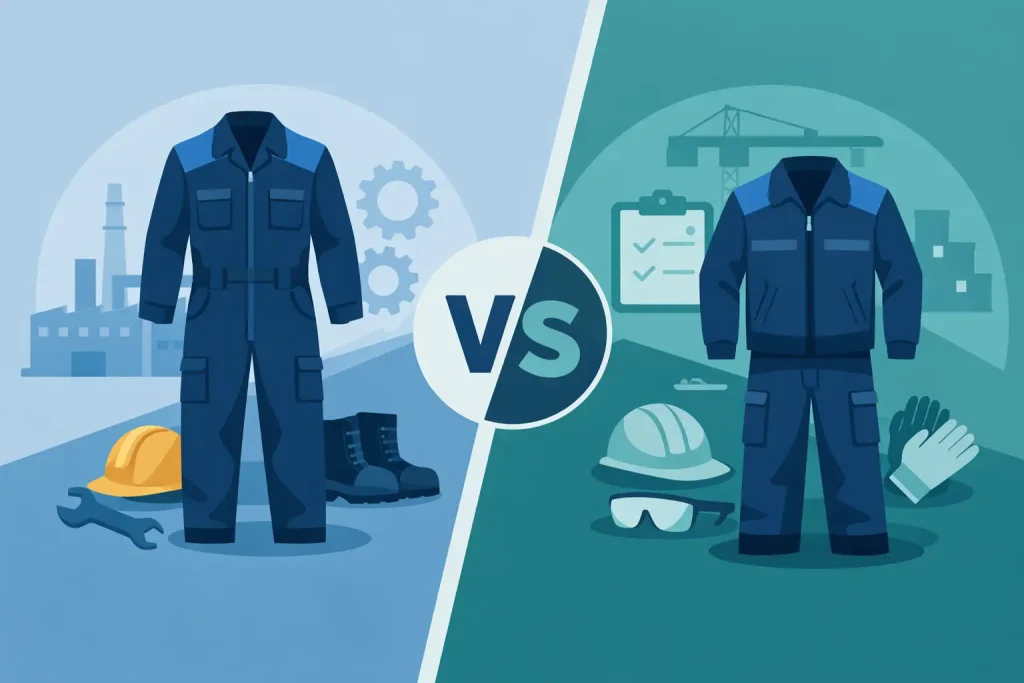
A coverall versus two piece decision usually comes down to one question: what needs to stay protected during the shift? For a mechanic working under vehicles, a one-piece garment can keep oil and debris off personal clothing. For a utility crew moving between outdoor work, vehicles, and heated facilities, separate pants and a shirt or jacket may be easier to layer, replace, and manage.
Neither option is automatically safer. The right choice depends on the hazard assessment, the required protective standard, the work being performed, climate, laundering process, and how often workers need to adjust or change their garments. Purchasing teams should evaluate the job first, then choose the garment format that supports compliance and daily wear.
Coverall Versus Two Piece: The Practical Difference
A coverall is a one-piece garment that covers the torso, arms, and legs in a single unit. Most work coveralls use a front zipper or snap closure, with features such as chest pockets, pass-through access, reinforced knees, elasticized waists, or reflective trim depending on the application. They are common in automotive service, industrial maintenance, painting, cleaning, food production, and some high-hazard environments.
Two-piece workwear separates upper- and lower-body protection. This may be a work shirt with work pants, an FR shirt with FR pants, or a protective jacket worn over matching trousers. The components can be issued as a uniform set, but each piece can also be selected by size, replaced separately, or layered with other approved clothing.
The main operational difference is continuity of coverage. A coverall reduces exposed gaps between shirt and pants when the wearer bends, reaches, crawls, or works overhead. Two-piece garments provide more adjustment at the waist and allow workers to remove or add upper layers without changing the entire outfit.
When a Coverall Makes Sense
Coveralls are often the efficient choice where workers encounter dirt, grease, dust, light liquid splash, or frequent contact with contaminated surfaces. A technician can put a coverall over base clothing at the start of a job, complete the task, and remove the outer layer before entering a vehicle, lunchroom, or cleaner work area. That process can help control the transfer of shop soil and process contamination.
For automotive and maintenance roles, a coverall also keeps the uniform simple. Supervisors can issue one garment type, workers have fewer pieces to coordinate, and the company presentation stays consistent across a crew. In operations where workers change garments at the facility, coveralls can simplify locker-room storage and laundering collection.
A one-piece design can also be useful where a shirt tail coming untucked creates an issue. Workers who climb, kneel, crawl, or reach frequently may prefer the continuous fit. The garment must still be sized correctly. A coverall that is too tight through the shoulders, crotch, or back can limit movement and wear out quickly. One that is too loose can snag on equipment or create excess material around moving parts.
Coveralls are not always the best choice for warm conditions. Removing a one-piece garment for a temperature change, restroom break, or rest period is less convenient than taking off a jacket or overshirt. In hot indoor facilities or summer field work, that inconvenience can affect worker acceptance and consistent wear.
When Two-Piece Workwear Is the Better Fit
Two-piece workwear is usually more flexible for crews working through changing temperatures and changing tasks. A worker can wear approved pants throughout the day and add a shirt, jacket, or outer layer as conditions require. This is practical for construction, utility, transportation, warehouse operations, and maintenance teams that move between indoors and outdoors.
Replacement cost is another advantage. Pants tend to wear differently from shirts, particularly for workers who kneel, carry tools at the waist, or work around abrasive surfaces. With separate garments, a damaged pant can be replaced without retiring a usable shirt. This can make inventory management easier for uniform programs with high turnover or varied body sizes.
Two-piece uniforms can also provide better fit control. Workers often need different sizes in tops and bottoms, and separate sizing supports a more functional fit. Better fit is not a cosmetic issue. It affects mobility, comfort, pocket access, and the likelihood that workers will wear the assigned garment correctly for the full shift.
For service and facility teams, two-piece uniforms may be the more practical daily option. Housekeeping, food processing support, healthcare support, culinary, and customer-facing maintenance personnel may need a clean, consistent uniform while still requiring easy laundering and replacement. A work shirt and pant program can meet those needs without the bulk of a coverall.
Protective Standards Come Before Garment Style
Do not select a coverall or two-piece system based on appearance alone when flame, arc flash, or visibility hazards are present. The garment type must match the hazard and the applicable workplace requirements.
For flash fire exposure, flame-resistant clothing may need to meet NFPA 2112 or CAN/CGSB 155.20, depending on the employer’s program and jurisdiction. These standards address protective workwear for hydrocarbon flash fire exposure, with CAN/CGSB 155.20 also covering optional protection related to steam and hot fluids.
For electrical arc flash work, employers must evaluate arc hazards and establish appropriate PPE under programs aligned with NFPA 70E in the United States or CSA Z462 in Canada. Arc-rated garments are selected for the task’s calculated incident energy or the applicable PPE category. A garment labeled flame-resistant is not automatically appropriate for every arc flash task.
High-visibility garments address a different hazard: worker conspicuity around vehicles, mobile equipment, and low-light conditions. CSA Z96 applies to high-visibility safety apparel in Canada. In the United States, jobsite requirements may reference other high-visibility specifications. Do not assume that an FR coverall is high visibility, or that a high-visibility vest provides flame or arc protection.
A two-piece FR system may be acceptable when both garments are approved for the required protection and worn as specified by the employer. Likewise, an FR coverall may be a practical option for the same environment. The decision must consider the full clothing system, including base layers, outerwear, closures, and any garments worn over the protective layer.
Fit, Layering, and Daily Wear
A protective garment only helps when workers can move and work in it. Before issuing a large order, have representative workers try the garments while climbing steps, reaching overhead, kneeling, sitting in equipment, and handling routine tools. Check sleeve length, inseam, shoulder movement, zipper operation, pocket placement, and the fit over required base layers.
Layering deserves special attention in cold weather. A coverall may fit well over light clothing but become restrictive over thermal layers. A two-piece system can allow more targeted layering, such as insulated pants with an approved FR shirt and outer layer. Where flame or arc hazards exist, every layer must be compatible with the protection plan. Non-compliant meltable fabrics can create additional risk when worn beneath or over protective apparel.
Laundering is part of the decision as well. Garments exposed to oils, chemicals, food residues, or industrial soils need cleaning procedures that preserve their performance. Follow the manufacturer instructions and the employer’s contamination-control process. Heavily contaminated protective clothing may require specialized handling rather than routine home laundering.
Buying for Crews Without Creating Inventory Problems
For a small team, issuing both formats to different roles may be the most sensible approach. Mechanics may receive coveralls, field technicians may receive separate workwear, and supervisors may receive a durable shirt-and-pant uniform suitable for site visits. Standardizing where possible still matters, especially for color, branding, approved protective categories, and replacement procedures.
For larger programs, build the purchase around job classifications rather than a single garment for every employee. Record the required standards, garment colors, size ranges, and replacement cycle for each role. Keep common sizes available, but do not force workers into a poor fit simply to reduce stockkeeping units.
Coverallsale supports this type of practical selection with workwear, FR clothing, arc flash PPE, high-visibility apparel, and job-specific protective garments for industrial and service operations. The objective is straightforward: match the apparel to the exposure, the task, and the way the crew actually works.
Common Questions
Are coveralls safer than two-piece workwear?
Not by default. Coveralls can reduce the chance of a gap between shirt and pants during active work, but safety depends on the specific hazard, garment rating, fit, condition, and correct use. A properly selected two-piece FR or arc-rated system can be appropriate when it meets the employer’s protective requirements.
Are two-piece FR garments acceptable for arc flash work?
They can be, provided the complete system is selected for the arc hazard and meets the employer’s requirements under NFPA 70E or CSA Z462. Check the arc rating of each garment and confirm that layering, closures, and any outerwear are included in the PPE evaluation.
Which option is better for mechanics?
Coveralls are often preferred for automotive and maintenance work because they provide continuous coverage against grease, dirt, and routine shop contact. Two-piece workwear can be better when heat, frequent changes, or separate sizing are priorities. The job’s exposure and the worker’s movement requirements should decide the issue.
Can high-visibility coveralls replace FR clothing?
No. High-visibility apparel is selected for visibility hazards, while FR and arc-rated clothing are selected for thermal and electrical hazards. Some garments may combine properties, but each required standard and rating must be verified before use. Choose the garment that fits the hazard assessment, then make sure the crew can wear it correctly every shift.
