
No products in the cart.
Industrial Workwear
Shock Absorbing Lanyard: What to Check
05
Jul
Jul
A shock absorbing lanyard is not a generic strap with a hook on each end. If it is part of your fall arrest system, it is there to manage arresting forces during a fall, help limit injury risk, and work as a matched component within the rest of your setup. On a job site, that means the right lanyard is not just a matter of preference. It affects clearance, mobility, anchor selection, worker capacity, and whether the system is being used within its rated limits.
For safety managers and buyers, this is where many purchasing mistakes start. A crew may ask for “lanyards,” but what they actually need depends on the task, the anchor location, the worker’s weight with tools, and whether they are tying off at foot level, overhead, or while moving between anchors. Treating all lanyards as interchangeable leads to poor fit for the application and, in some cases, a system that should not be used at all.
What a shock absorbing lanyard actually does
A shock absorbing lanyard is designed for personal fall arrest, not simple positioning or travel restraint. Its key function is to reduce the force transmitted to the worker and anchorage during fall arrest. That usually happens through an internal or external energy absorber that deploys under load.
Without that energy absorption, the stopping force in a fall can be much higher. The lanyard may still stop the fall, but the loads on the body and system can be severe. That is why product selection should focus on more than length and connector style. The energy absorber, maximum arrest force, and compatible use conditions matter just as much.
On active industrial sites, this matters most where workers are climbing, connecting at elevation, or moving across structures with changing anchor points. Construction, utilities, oil and gas, and maintenance work all create situations where a standard fixed-length connector may be easy to grab but not necessarily right for the exposure.
The specs that matter before you buy
If you are comparing one shock absorbing lanyard to another, start with the performance details instead of the price. Length is important, but it is only one part of the decision.
Capacity range
Check the worker weight capacity, including clothing, tools, and carried equipment. This is where industrial crews can exceed assumptions quickly. Heavy outerwear, tool belts, radio gear, and winter conditions all affect total working weight. If the lanyard is not rated for the actual user and carried load, it is the wrong product.
Free fall rating
Not every lanyard is intended for the same tie-off conditions. Some are for overhead anchorage and limited free fall. Others may be rated for greater free fall distances or foot-level tie-off, provided the rest of the system also supports that use. This is a major point of separation between products that look similar in a catalog.
Deceleration distance and total fall clearance
This is one of the most overlooked checks in the field. A lanyard may be acceptable in principle, but if there is not enough clearance below the worker to fully arrest the fall safely, the system is not suitable for that location. Deceleration distance, worker height, harness stretch, connector movement, and a safety margin all need to be considered together.
Connector type
Snap hooks and rebar hooks are not interchangeable just because both attach. The anchor structure, the D-ring connection, and the chance of rollout or side loading should drive connector selection. Large rebar hooks may be necessary for structural steel or bigger anchor members, while standard hooks may fit other systems better.
Single-leg or twin-leg design
A single-leg lanyard may be enough for fixed work at one anchorage point. A twin-leg design is often used where 100 percent tie-off is needed during movement from one anchor to the next. If the worker will be transitioning frequently, that second leg is not a convenience feature. It is often the only practical way to stay continuously connected.
Choosing the right shock absorbing lanyard for the job
The right choice depends on how the work is being done, not just what industry you are in. Two crews at the same facility may need different fall protection setups because the anchor heights, travel paths, and work positioning demands are different.
For overhead work with adequate clearance, a standard energy-absorbing lanyard may be appropriate if it fits the worker capacity and the connectors match the anchor and harness hardware. For steel erection, climbing, or movement along structures, twin-leg options are often a better operational fit. For lower anchor points, selection gets more restrictive because free fall and clearance requirements become harder to manage.
This is also where buyers should be careful not to substitute based on availability alone. If a product is in stock but not rated for the needed tie-off condition, that is not a workable replacement. A lower-cost option can become an expensive mistake if it creates a noncompliant setup or has to be removed from service once the task is reviewed.
Common buying mistakes on industrial sites
One of the biggest mistakes is buying solely by length. A 6-foot lanyard is common, but that does not make it universally correct. In some locations it creates too much free fall or requires more clearance than the work area allows.
Another frequent issue is overlooking total system compatibility. The lanyard is only one part of fall protection. It has to work with the harness, anchorage, connectors, and the actual work environment. Sharp edges, heat, chemical exposure, and abrasive conditions can all affect whether a given web or hardware configuration is appropriate.
Buyers also sometimes assume that if a lanyard is labeled for fall arrest, any trained worker can use it the same way. In practice, user weight, tool load, and anchor location change the answer. A product that is suitable for one worker in one task may not be suitable for another worker on the same site.
Inspection and replacement are not optional
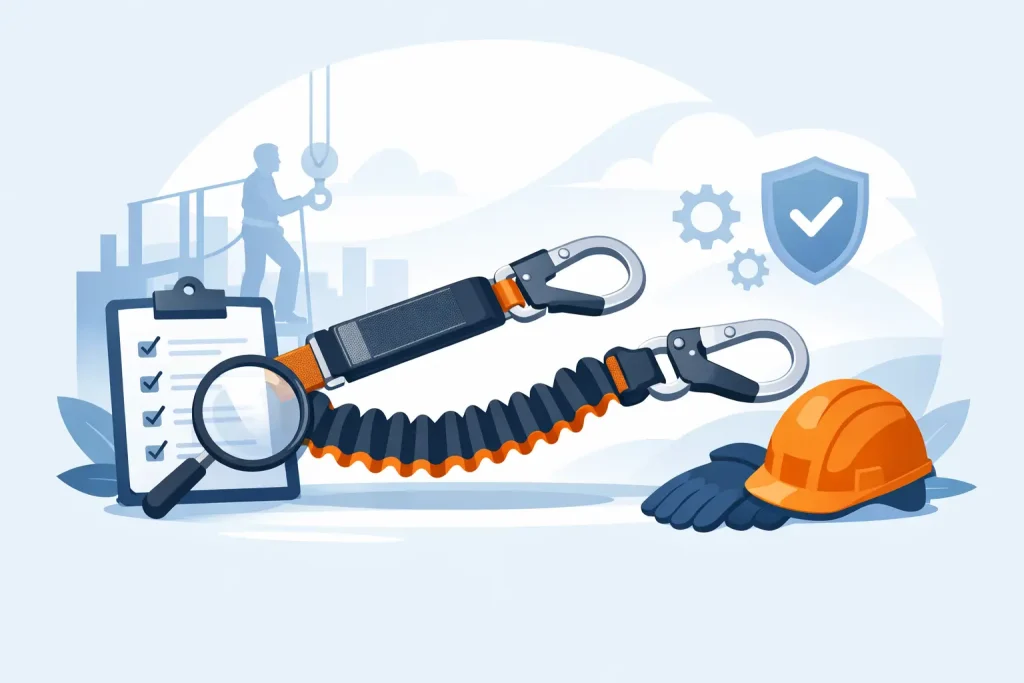
A shock absorbing lanyard should be inspected before use and according to the employer’s inspection program. Webbing damage, cuts, burns, fraying, chemical deterioration, damaged stitching, deformed hardware, missing labels, or any sign that the energy absorber has deployed are reasons to remove it from service.
This is not an area for guesswork. If the shock pack has been activated, the lanyard has done its job and should not go back into use. The same applies if the product history is unknown or the identification markings are no longer readable. Procurement teams should keep replacement cycles and spare stock in mind, especially where multiple crews depend on the same PPE category.
For larger operations, standardizing approved lanyard types can reduce confusion, but only if that standardization is built around the actual tasks being performed. A simpler SKU list helps purchasing, but it should not force workers into one configuration that fits some tasks and not others.
Compliance starts with the right hazard category
Fall protection should be treated as its own hazard category. That sounds obvious, but it matters in mixed PPE environments where buyers are also sourcing arc flash clothing, FR garments, high-visibility apparel, respirators, and general workwear. Each category has its own standards, use conditions, and limits. They are not interchangeable just because they are all safety products.
For example, fall protection equipment selection should not be confused with standards used for flame-resistant or arc-rated garments. NFPA 2112, NFPA 70E, CAN/CGSB 155.20, CSA Z462, and CSA Z96 address different hazards and different performance requirements. A worker may need compliant clothing and fall protection at the same time, but one does not replace or certify the other.
That is one reason many industrial buyers prefer a supplier that understands category-specific PPE selection rather than treating all work gear as general apparel. Coverallsale serves that type of buyer, where the question is not just what size to order, but what hazard the gear is meant to address.
What good purchasing looks like
A good purchase decision starts with the task. Where is the anchor point? How much clearance is available? Will the worker move between anchors? What is the total working weight? Is there exposure to edges, welding, heat, or contaminants? Those answers narrow the field fast.
From there, compare product ratings, connector style, leg configuration, and inspection requirements. If the site has several work scenarios, it may make more sense to approve more than one lanyard type rather than forcing one model into every job. That usually improves both compliance and day-to-day usability.
The best fall protection purchase is not the one with the shortest spec sheet or the lowest unit cost. It is the one that fits the task, the worker, and the site conditions without creating workarounds in the field.
Common Questions
What is the difference between a shock absorbing lanyard and a positioning lanyard?
A shock absorbing lanyard is used for fall arrest and is designed to reduce arrest forces during a fall. A positioning lanyard is used to help hold a worker in place and is not a substitute for a fall arrest system unless the full system is specifically designed for that purpose.
Can a shock absorbing lanyard be used for foot-level tie-off?
Only if the manufacturer rates that specific lanyard for foot-level tie-off and the full fall clearance requirements are met. Many lanyards are not intended for that use.
How often should a shock absorbing lanyard be inspected?
It should be inspected before each use and as part of the employer’s documented inspection program. Follow the manufacturer’s instructions and remove any damaged or deployed lanyard from service immediately.
Does lanyard length always mean more protection?
No. A longer lanyard can increase free fall distance and total clearance requirements. The right length depends on anchor location, work movement, and available clearance below the worker.
A careful lanyard choice usually saves time later, because crews can work with gear that fits the task instead of trying to work around it.
