
No products in the cart.
Industrial Workwear Automotive
Best Mechanic Shop Uniforms for Daily Service Work
13
Jul
Jul
What Makes the Best Mechanic Shop Uniforms?
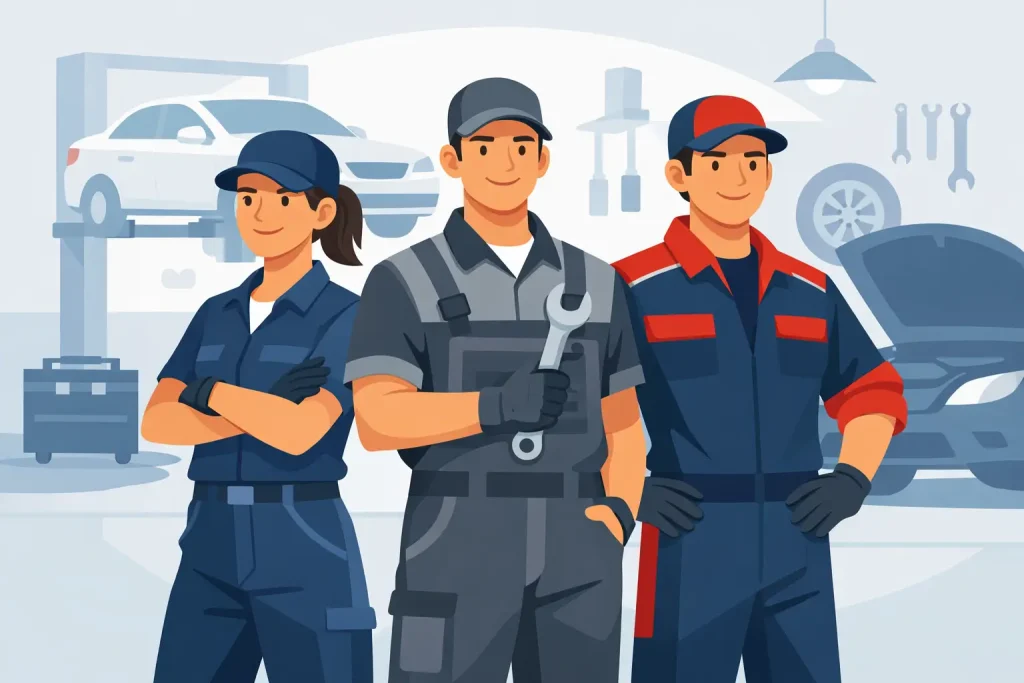
For most mechanical shop uniforms the core uniform is a service work shirt paired with work pants or a coverall. Button-front or snap-front work shirts give the crew a clean, identifiable appearance while allowing fast removal if a shirt becomes heavily soiled. Work pants should have a practical rise, reinforced stress points, and enough room through the seat and knees for movement. Dark navy, charcoal, black, and gray are common choices because they manage the appearance of grease and shop soil better than light colors.
A good mechanic uniform has to work in motion. Technicians bend over fenders, reach into engine bays, kneel at wheels, and climb in and out of vehicles all day. Restrictive sleeves, shallow pockets, weak seams, and waistbands that bind become daily problems quickly.
Durability is not just about heavy fabric. Look at the parts of the garment that fail first: pocket corners, crotch seams, knee areas, cuffs, zipper tracks, and closures. Bar-tacked stress points, reinforced knees, quality stitching, and dependable closures usually provide more value over a uniform’s service life than a lower upfront price.
Comfort matters for retention and compliance. If the uniform is hot, stiff, poorly sized, or difficult to clean, employees will look for alternatives. A poly-cotton blend often provides a practical balance of durability, color retention, and easier laundering. All-cotton options may feel more breathable, while stretch panels or stretch-blend fabrics can help technicians who spend much of the shift crouching and reaching. The best choice depends on shop temperature, climate, laundry practices, and the actual work being done.
A technician who spends the day under vehicles, handling fluids, moving tires, and working around hot components needs more than a shirt with a shop logo. The best mechanic shop uniforms keep crews comfortable through long shifts, present a consistent image to customers, and hold up against the stains, abrasion, and repeated laundering that come with service work.
The right uniform program also prevents a common purchasing mistake: treating all mechanic apparel as protective equipment. A durable work shirt and pants can be the right choice for general automotive repair, but they are not automatically flame-resistant, arc-rated, high-visibility, or suitable for chemical splash exposure. Start with the job tasks and hazards, then select garments that fit the work.
Choose Mechanic Uniforms by Job Role
Not every employee in an automotive operation needs the same garment. Standardizing the entire crew in one uniform can simplify ordering, but it may create unnecessary cost or leave certain roles without the features they need.
General Repair Technicians
General repair technicians usually need a durable work shirt and pants, or a coverall where full-body coverage is preferred. Multiple pockets are useful for pens, inspection lights, small tools, and work orders, but oversized pocket designs can snag on equipment or collect debris. A clean, simple construction is often the better long-term choice.
Coveralls are especially practical for employees who regularly work under vehicles or encounter heavy grease and dirt. They protect personal clothing and create a uniform appearance with one garment. The trade-off is heat. In warm bays or summer conditions, a two-piece shirt-and-pant uniform may be more comfortable and easier to manage during breaks.
Lube, Tire, and Quick-Service Teams
Fast-paced service roles require mobility and easy replacement. Shirts and pants are usually more practical than coveralls because workers may change garments more often after oil or fluid exposure. Select pants with durable knees and fabrics that tolerate frequent industrial laundering.
For tire work, consider abrasion resistance and fit around the knee. Loose pant legs can catch on equipment, while overly slim cuts can restrict movement. Footwear is also part of the uniform decision, even when it is purchased separately. Slip resistance, toe protection, and resistance to automotive fluids should match the facility’s safety requirements.
Service Advisors and Customer-Facing Staff
Service advisors do not typically need the same rugged uniform as technicians, but they should still look connected to the operation. Branded polos, work shirts, or durable button-front shirts in coordinated colors create a consistent handoff from the service counter to the shop floor.
Keep customer-facing apparel separate from heavily soiled repair uniforms. This is a simple operational decision that protects the shop’s presentation and gives employees garments suited to their work area.
Mobile Mechanics and Roadside Service Crews
Mobile mechanics face a different exposure profile. Working near traffic, in parking lots, or along roadways may require high-visibility apparel based on the worksite assessment and local requirements. High-visibility clothing is not a general substitute for a mechanic uniform. It must be selected for the visibility risk and, where applicable, meet the required standard such as CSA Z96 in Canadian applications.
Weather protection also matters. Rainwear, insulated layers, and high-visibility outerwear should fit over the base uniform without restricting access to tools or creating loose, snag-prone layers.
Fabric, Color, and Laundry Are Operating Decisions
Uniform programs often fail at the laundry stage. Oil, grease, coolant, adhesives, and shop dirt can shorten garment life when workers use inconsistent cleaning methods. Before purchasing, decide whether employees will wash uniforms at home or whether the business will use a uniform service or industrial laundry provider.
Home laundering may reduce direct program costs, but it can lead to inconsistent appearance, staining, shrinkage, and faster replacement. A managed laundry program can improve consistency, although it adds recurring cost and may limit garment options. There is no single right model. The better choice is the one that matches staffing levels, soil load, replacement expectations, and available budget.
Color selection affects both appearance and inventory control. Dark colors hide stains but can make it harder to spot certain contaminants. Lighter colors show soil quickly and may be appropriate for service advisors or clean assembly areas. Many shops use a dark technician uniform with a separate color for advisors, managers, or specialty teams. This makes roles clear without adding unnecessary complexity.
When a Mechanic Uniform Must Also Be PPE
Automotive work can involve hazards beyond ordinary grease and abrasion. Welding, cutting, grinding, battery work, fuel handling, electrical service, and work on fleet or industrial equipment may require task-specific PPE. A standard poly-cotton uniform should not be assumed safe for flash fire, arc flash, chemical splash, or welding exposure.
If a hazard assessment identifies flash-fire risk, select flame-resistant garments appropriate to that hazard. NFPA 2112 applies to flame-resistant garments intended to protect industrial personnel from flash fire. CAN/CGSB 155.20 is the Canadian standard for workwear protection against hydrocarbon flash fire and, optionally, steam and hot fluids. These standards address flash-fire protection, not electrical arc flash protection.
For electrical arc flash work, apparel selection must follow the electrical safety program and hazard assessment. NFPA 70E provides workplace electrical safety requirements in the United States, while CSA Z462 addresses workplace electrical safety in Canada. Arc-rated clothing is selected using the applicable incident energy or PPE category requirements. Do not treat FR clothing as automatically arc-rated, and do not treat arc-rated clothing as a substitute for every other form of PPE.
Technicians performing welding or cutting may need welding-specific protective clothing, gloves, face protection, and other equipment based on the process and exposure. Chemical splash protection, respiratory protection, hearing protection, and fall protection should also be selected separately when the task calls for them. A uniform is one layer of the program, not the entire program.
Build a Uniform Program That Is Easy to Reorder
The most effective uniform programs use a limited number of approved garments. Start with a standard shirt, pant, and coverall option, then add role-specific pieces only where needed. This reduces ordering errors, simplifies logo application, and makes replacement inventory easier to manage.
Set clear rules for sizes, colors, logo placement, and replacement timing. Keep a size run available for new hires and seasonal staff. If several mechanics prefer different garment cuts, allow controlled options within the same color and branding standard rather than forcing a single fit that does not work for the whole crew.
Buy samples before issuing a large order. Have technicians wear-test them during real tasks, including kneeling, lifting, reaching, and working in hot bays. Check pocket access, closure durability, fabric comfort, and how the garment looks after repeated washes. This small step can prevent a costly uniform change that employees reject after the order arrives.
Common Questions
Are coveralls better than mechanic shirts and pants?
It depends on the job. Coveralls provide more complete coverage and work well for undercar service, heavy grease, and dirty repair tasks. Shirts and pants are usually cooler, easier to change, and more practical for quick-service teams or shops with warm work areas.
What fabric is best for mechanic uniforms?
Poly-cotton blends are a common choice because they balance durability, comfort, color retention, and laundering performance. All-cotton, stretch-blend, and FR fabrics may be better for specific work conditions, but each should be selected based on the task and hazard assessment.
Do automotive mechanics need flame-resistant uniforms?
Not always. General automotive repair does not automatically require FR clothing. FR garments are needed when the work exposes employees to flash-fire hazards or when the employer’s hazard assessment and safety program require them.
Can standard mechanic uniforms be used for arc flash work?
No. Standard uniforms are not automatically arc-rated. Electrical work with arc flash exposure requires apparel selected according to the applicable electrical safety program, such as NFPA 70E or CSA Z462, and the identified incident energy or PPE category.
How many uniforms should each mechanic receive?
A practical starting point is enough garments to cover a full workweek plus spare sets for laundering, unexpected contamination, and replacement. The right quantity depends on soil level, laundry turnaround, shift schedule, and whether the business provides cleaning. Put the uniform through the same work your crew performs, and the right specification will become clear quickly.
